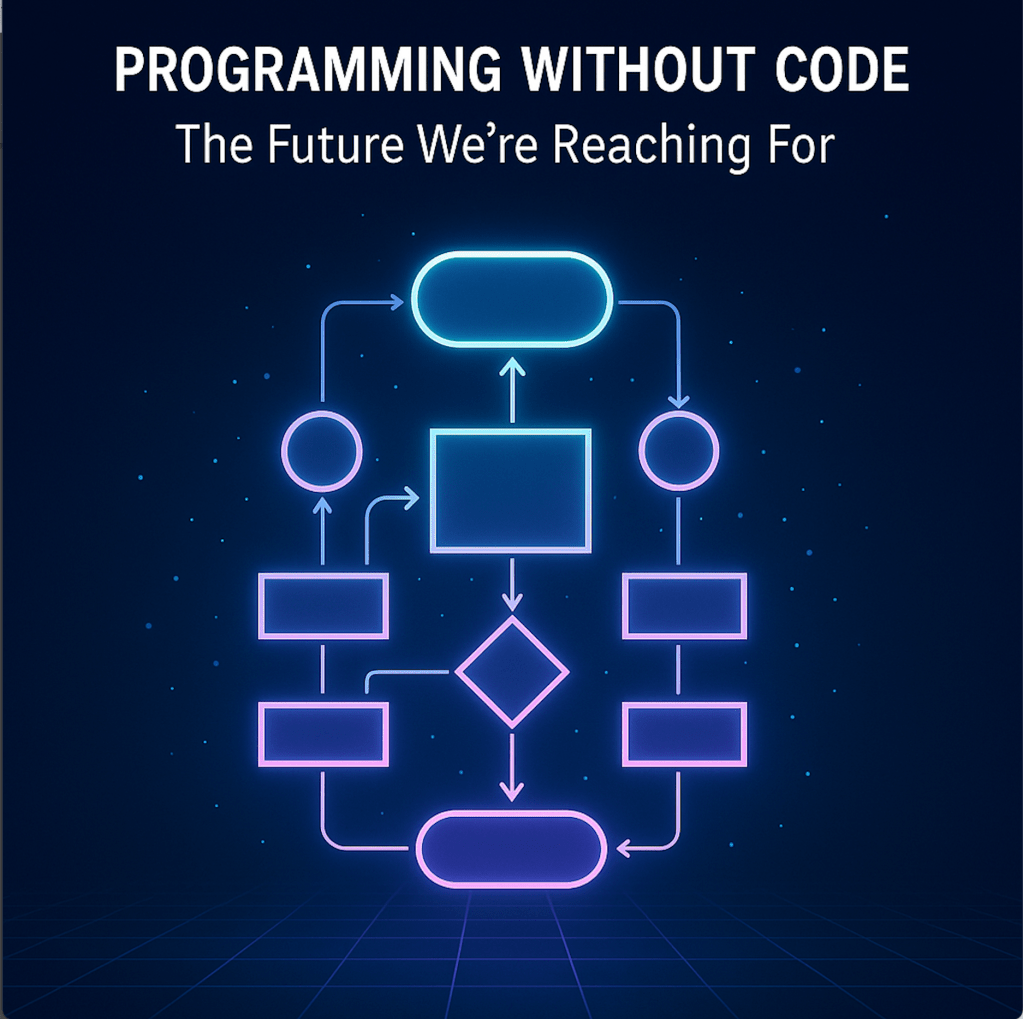
For decades, the software engineering world has nurtured a bold vision: replacing lines of code with intuitive, high-level diagrams that can directly instruct machines. A future where developers, business analysts, and even non-technical stakeholders could collaborate seamlessly, designing systems as easily as sketching an architectural blueprint.
As of August 14, 2025, this dream is no longer confined to research papers or science fiction—it’s unfolding before our eyes.
Where We Stand Today
Several key technological trends have brought us closer to diagram-based programming:
- Low-Code and No-Code Platforms
Tools like Mendix, OutSystems, and Microsoft Power Apps already allow applications to be assembled visually, reducing dependency on traditional code for many use cases. - Model-Driven Engineering (MDE)
This approach uses abstract models to generate executable systems automatically, aligning software design with business objectives. - AI-Assisted Development
Artificial Intelligence can now interpret hand-drawn sketches, flowcharts, or UML diagrams and transform them into working prototypes within hours. - Domain-Specific Visual Languages
Specialized visual syntaxes for robotics, IoT, and data pipelines are proving that complex processes can be expressed clearly without text-based programming.
The Gaps That Remain
While the progress is impressive, we are not yet in an era where diagrammatic languages fully replace code. The key challenges include:
- Semantic Precision – Diagrams must be as formally precise as code, leaving no room for ambiguity in execution.
- Scalability – Visual representations often break down when systems grow beyond a certain size or complexity.
- Bidirectional Synchronization – Ensuring that changes in the visual model are perfectly mirrored in the underlying executable code—and vice versa—remains technically demanding.
- Lack of Standardization – The industry still lacks a universally accepted visual programming standard, slowing widespread adoption.
Why This Matters
The implications go beyond convenience.
A robust, standardized diagrammatic language could:
- Democratize Software Development – Allowing subject matter experts without coding skills to directly contribute to system creation.
- Enhance Collaboration – Providing a shared, visual language that bridges technical and business perspectives.
- Accelerate Innovation – Reducing the gap between concept and implementation.
The Role of AI in Bridging the Gap
Artificial Intelligence is the missing link. With advanced natural language processing, machine learning models, and real-time code generation, AI can:
- Interpret human intent from diagrams and context.
- Automatically optimize visual models for performance and maintainability.
- Enforce formal rules and constraints without sacrificing creative freedom.
At Smart Business Solution S.r.l., we are actively exploring AI-driven solutions that integrate diagrammatic modeling with code-level precision—making it possible to go from idea to deployable product faster than ever before.
Looking Ahead
The dream of programming without code is no longer a distant aspiration—it is a technological horizon we are steadily approaching.
The shift will not happen overnight, but the trajectory is undeniable:
In the future, designing software will feel less like writing instructions for a machine and more like composing a symphony of interconnected ideas, visually mapped and instantly executable.
We believe this transition will redefine the very nature of software engineering.
The future is drawing itself—and we’re here to shape it.
#AI #FutureOfProgramming #NoCode #LowCode #Innovation #SmartBusinessSolution #SoftwareDesign


 "SMART BUSINESS SOLUTION: Innovazione Intelligente per un Futuro di Successo!"
Lascia un commento